If you've spent months tuning a Grok Bot setup in one place, plan on tuning the setup again when you take the setup somewhere new. Connecting the apps goes fast now. Getting the Bots to communicate the way you want, with you and with each other, comes from training and feedback inside the new company, and a prompt or template from someone else won't skip that step.
I'm a Dagny Field Advisor, which means I write from inside the companies I work with about what holds up when Dagny's way of working meets a new team. This note comes from moving my own setup into one of those companies.
What I brought with me
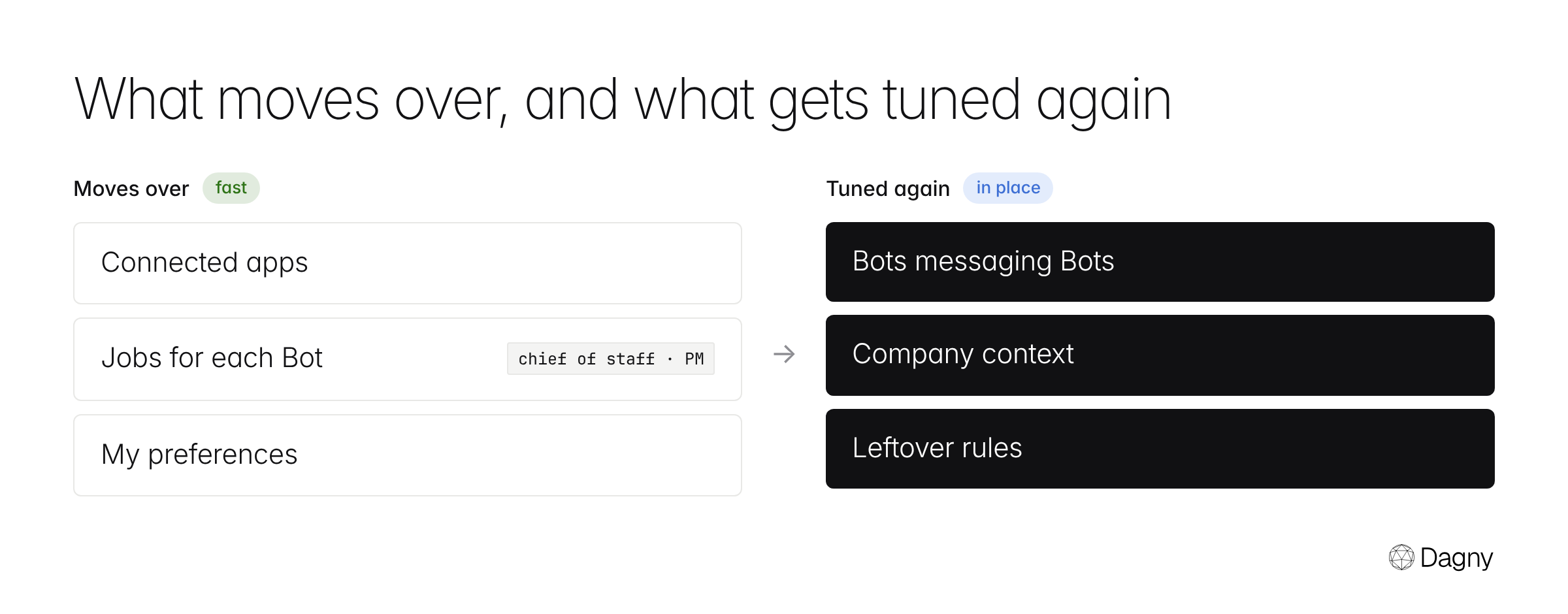
At Dagny, I spent months refining a Grok Bot setup. The Bots learned how I like to be communicated with. In Slack, a teacher Bot and a trainer Bot already message each other, and I never had to set that up.
The company I'm working with now already had an AI coding tool, a data warehouse and enough connected context that I could learn how the organization works: where the gaps are, who the people are, how information flows and where I fit. I made a point of onboarding with Grok Bot alone, and that part worked. I got a real picture quickly.
Porting the setup I had already tuned was harder than I expected.
What didn't travel
The high-level jobs were clear enough. I wanted a chief of staff Bot, a project manager Bot and the other Bots I rely on. I wanted the chief of staff Bot to be the door to me, and I wanted my Bots to talk to other people's Bots in Slack, the same way we already work as a team.
That last part has been hard. In the new workspace, the Bots won't message each other the way the teacher Bot and the trainer Bot do at Dagny. Telling the Bots what I want is different from refining how they communicate with me.
A colleague and I spent a couple of days on small breakages that are easy to miss. One Bot picked up a rule I had forgotten to remove from a Notion page of Bot rules and started following only that rule. Sometimes you have to start from zero again, even when you think you're just moving a system that already works.
One idea I keep coming back to from Dagny is that AI work stalls when the people building lack context on the systems and the team. My Bots arrived with my preferences and none of the new company's context, so the tuning had to start over inside the new company.
Will at Dagny, another Agentic Athlete, has seen the same unevenness in his own setups. Some of his Bots are so good he barely has to step in, and others are good but not at that level. He's still working out what makes the difference. His working theory is that the gap comes from the training, feedback and reinforcement you give along the way, and from how long you spend tuning a setup before the Bots start communicating with each other well.
Why the work is in the tuning
Connecting apps helps, and hooking systems up takes much less work than before. Refining the Bots and making them useful still takes work.
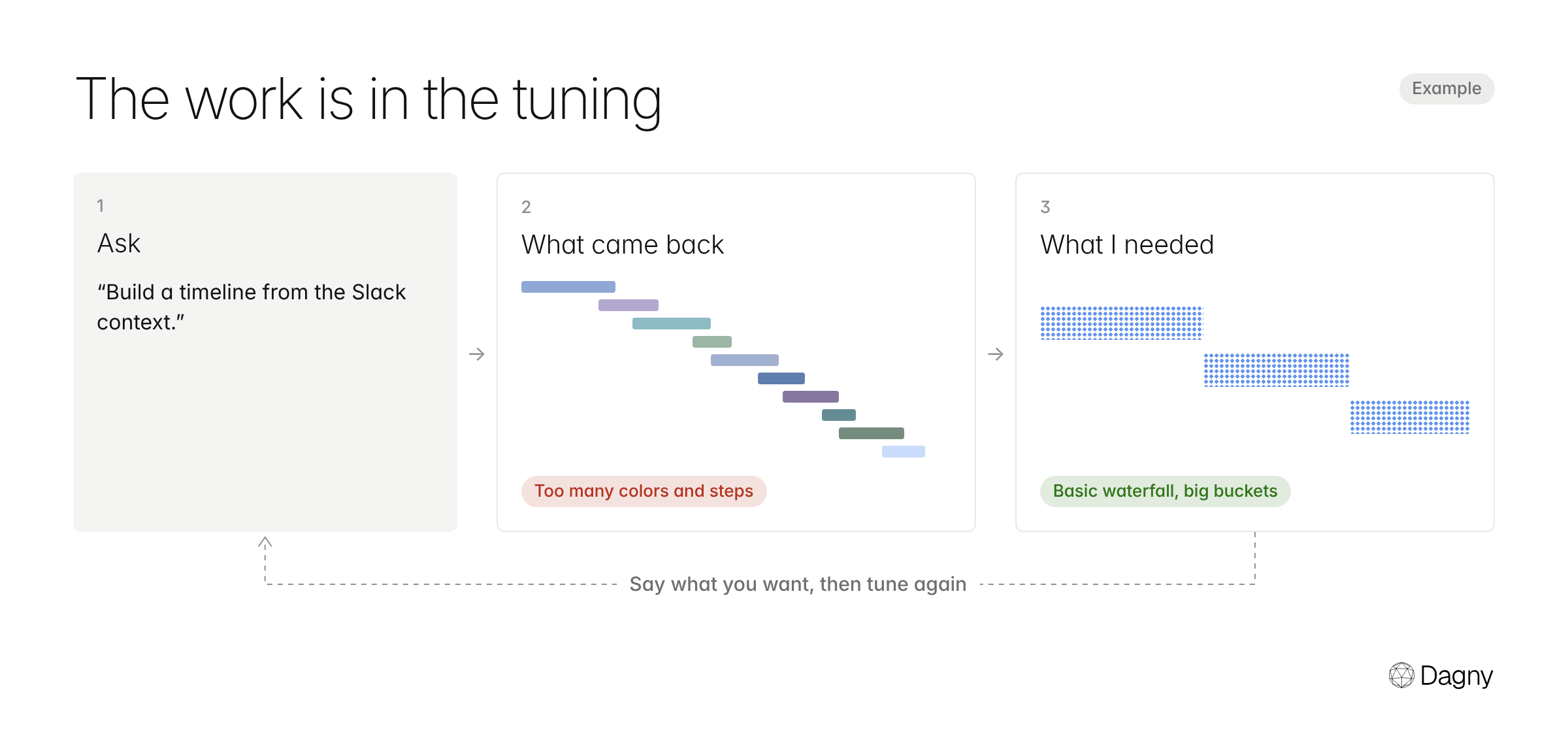
I asked a Bot to take the Slack context I already had and build a timeline I could look at. What came back was over-indexed on design, with too many colors and too many small steps. I needed a basic waterfall with big buckets, not a polished chart. I hadn't been specific enough about the output, so the Bot filled in a version I didn't ask for. You have to say what you want and then keep tuning.
Why we share what we learn
Others I've spoken with describe the same unevenness. Some people are only a few months into these tools and already imagining what they could build, while others are still using AI as a simple chat. A lot of the work is still ahead.
Firms can be furtive about the AI they use. I think the more useful stance is to talk openly about what we're seeing in the field. As Will at Dagny puts the idea, the edge comes from how quickly and how intentionally you move, and from what you do on top of these tools.
The systems will change in a couple of months anyway. If a method makes someone better and helps their organization, they should take the method. Sharing doesn't mean giving away internal IP or sensitive information. Sharing means being honest that this work isn't plug and play, and that the useful part is the experience: the misses, and the hypotheses for why a setup that works in one place doesn't automatically work in another.
This work can look simple from the outside, which is part of why I write down what happens inside a real company. More field notes from Dagny are at dagnyai.com.
Postscript: from a chat to a field note
This note went from a conversation to a published draft in less time than the conversation took.
- Will at Dagny and I talked through my experience transitioning the Grok Bot setup.
- AI transcribed the conversation.
- I gave Grok Bot one prompt.
- Grok Bot pulled the transcript, read Dagny's earlier field notes and the SpaceX AI writing guidelines (given Dagny is a registered SpaceX Super Intelligence Transformation Partner), and drafted two versions for me to review in about two minutes.
- I reviewed the drafts in two passes over about five minutes.
- Once I approved a version, Grok Bot sent the draft to Will in Slack for sign-off.
- Will asked Grok Bot for one more pass using a writing QA skill that also pulled in another model for image generation, reviewed the result and approved the note to ship.
The time from a thought to action keeps compressing. What stays human is the judgment at each step: what to say, and whether the draft says what we meant.
Dagny is a registered SpaceX Super Intelligence Transformation Partner.