Jev, the first System One model from TypeSafe, makes fast, narrow decisions instead of writing text. You give Jev a state and a typed question, and Jev returns a typed answer with a probability calibrated against outcomes, so across a lot of calls, 0.8 means about what the number says. We run Jev in production in places where we used to parse an LLM's text or keep editing rules and regex: a client's data pipeline and a real-time sentiment read inside an agentic messaging app.
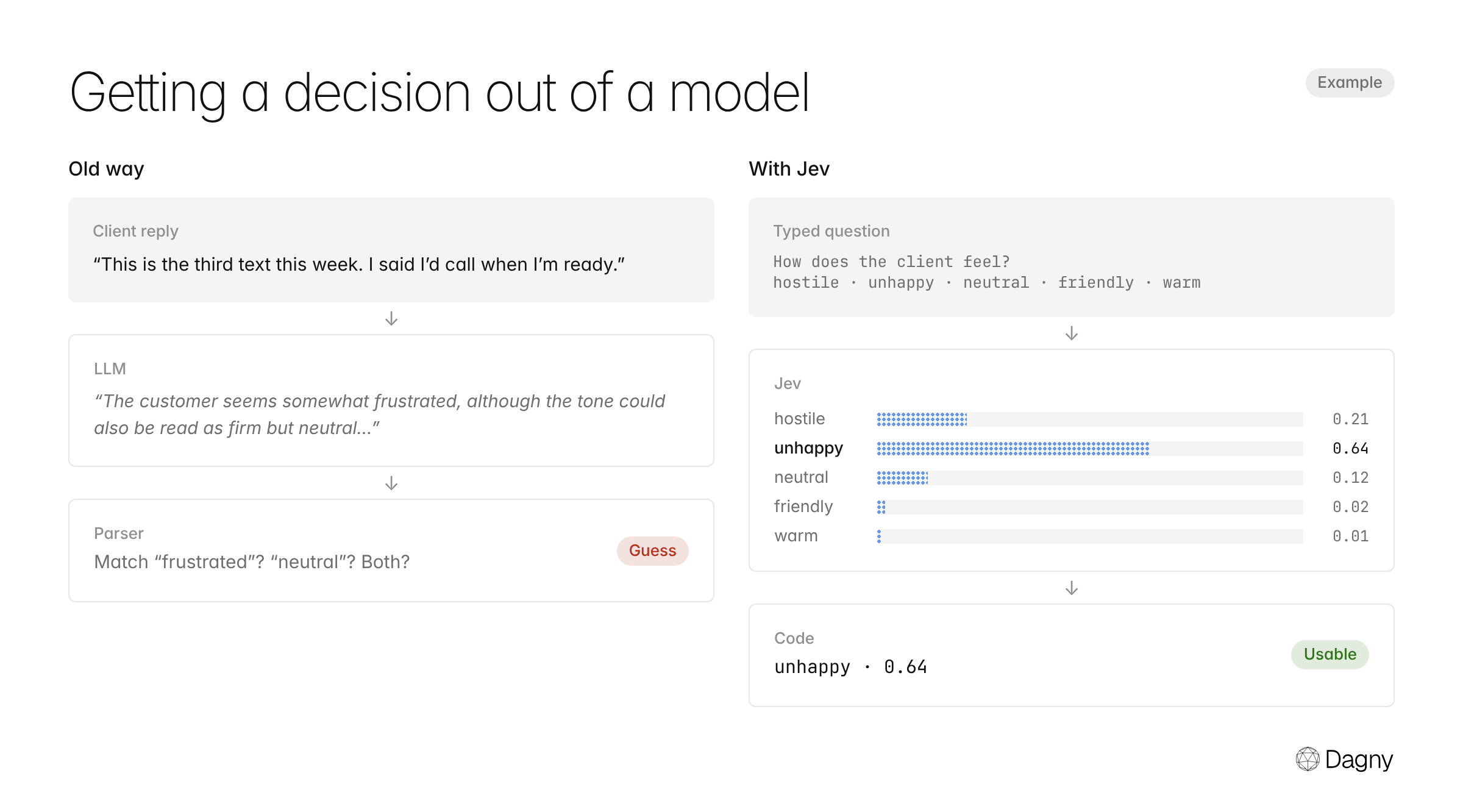
Data pipelines: classification
One client's data platform takes in records from a couple of upstream sources. Every record carries a free-text field, which might be abbreviated, uppercase, misspelled or padded with junk at the end. Downstream reporting needs each field classified into one of ten categories.
Before Jev, that ran on many keyword rules in SQL, with complex regex trying to fit every case, and the rules didn't keep up. The biggest bucket was "other." We had a couple hundred thousand distinct values, which made the job too messy for regex. We also received new values we haven't seen very often, and rules written for today's records won't work with the new one. This isn't a new problem, and happens very often in classification pipelines.
Here is how we used Jev to classify these records:
- Each distinct name gets classified once with a Jev choice. Each of the ten classes has a written definition with examples, and that text is basically the spec.
- The answer lands in a warehouse table with the label, the confidence, the full probability spread, the pinned model version and the version of the definitions used.
- A dbt model reads that table. At 0.6 confidence or above, the label flows through. Below 0.6, the name falls back to "other," the same default the old rules had.
- A daily job only sends names that haven't been classified yet for that model and that version of the definitions. Everything else comes from the cache to save on token usage.
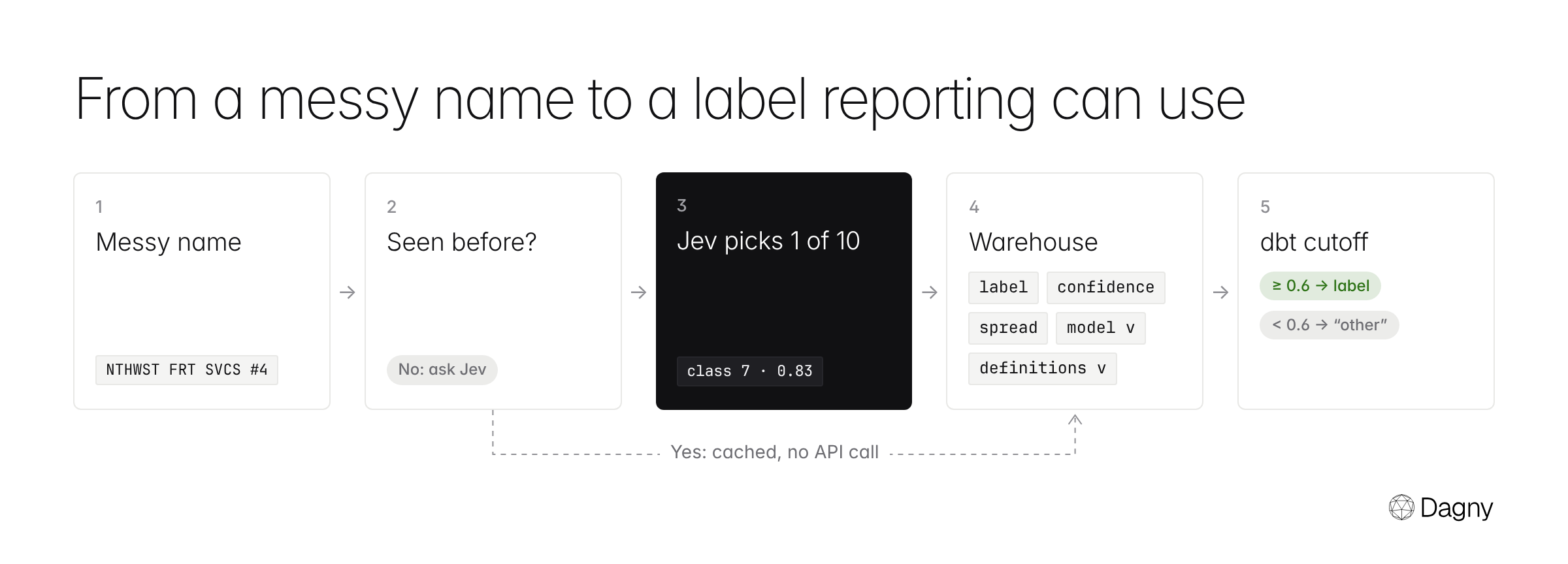
Two parts of that design mattered more than we expected. The cutoff lives in dbt, so moving the cutoff means a rebuild with no new API calls. And because the model and spec version is pinned and part of the cache key, we choose when an upgrade happens instead of having results shift under us.
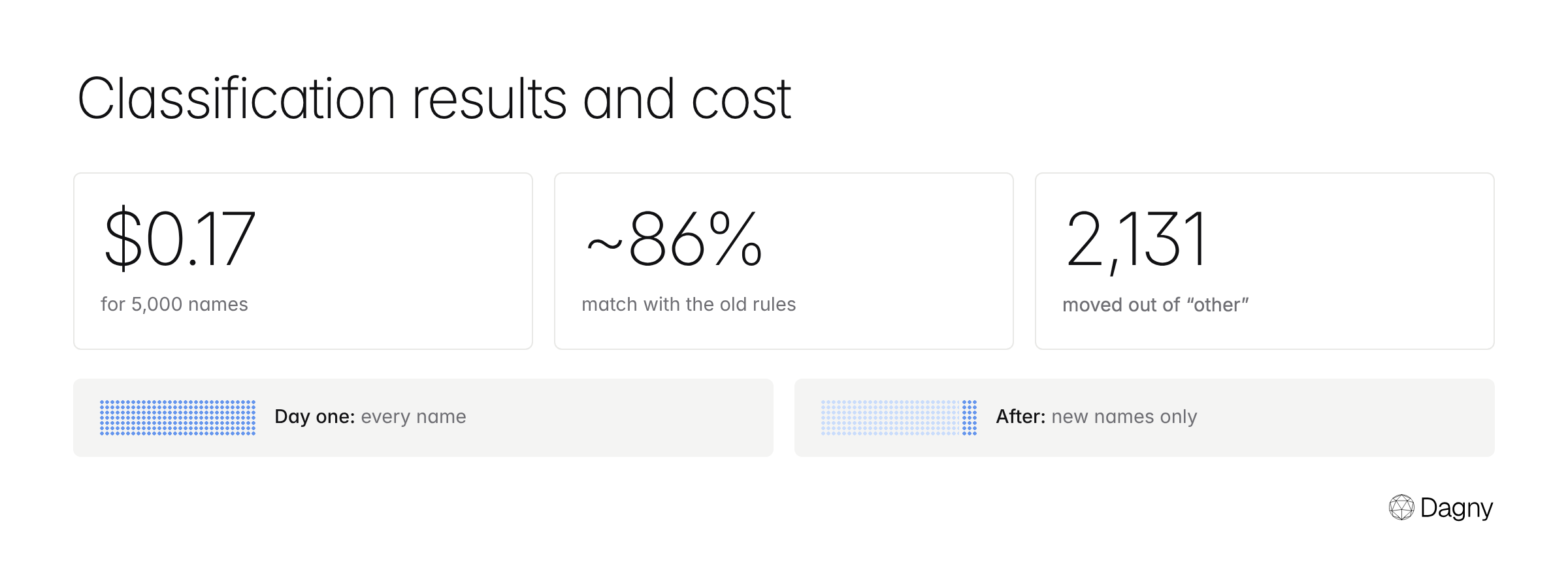
In the first test batch, 5,000 names cost $0.17. Where the old rules had an answer, Jev agreed with the rules on about 86% of names. We analyzed the disagreements, and most of them went Jev's way. Jev also placed 2,131 names the rules had left in "other." A full run classifies every distinct name once. After that one-time run, the daily job only pays for names we haven't seen before.
Real-time sentiment in agentic apps
In an app where people are talking, Jev gives a quick read that code can act on in real time.
We use Jev in a messaging app where users and agents talk to their clients over text. Every time a client replies, Jev reads how the client feels, and when the read comes back low, the conversation gets flagged right away so a person can take over. The same reads let us analyze sentiment by segment, so we can see where conversations tend to go badly and not only which single conversation did.
What goes in is small: the client's reply plus the last message we sent. Only the reply gets judged. Our message is there for context, so a short "no" to a question reads as neutral instead of upset.
The question is one score on five levels: hostile, unhappy, neutral, friendly and warm. Each level is written as a situation, not a degree. Unhappy is annoyed or complaining without abuse. Hostile is insults, threats to report you, or angrily asking to be left alone. Jev never sees a number, only the written levels, and hands back a probability for each level.
Code does the rest:
- The probabilities become a 0 to 1 score, the most likely level and a confidence.
- Under 0.35 confidence, we keep the read but mark the read as uncertain.
- If the score moves 0.15 or more between two replies, the conversation shows as warming or cooling to capture the trend.
- The read is saved on the message, and the latest read is saved on the conversation, so every thread in the inbox shows a level and a trend.
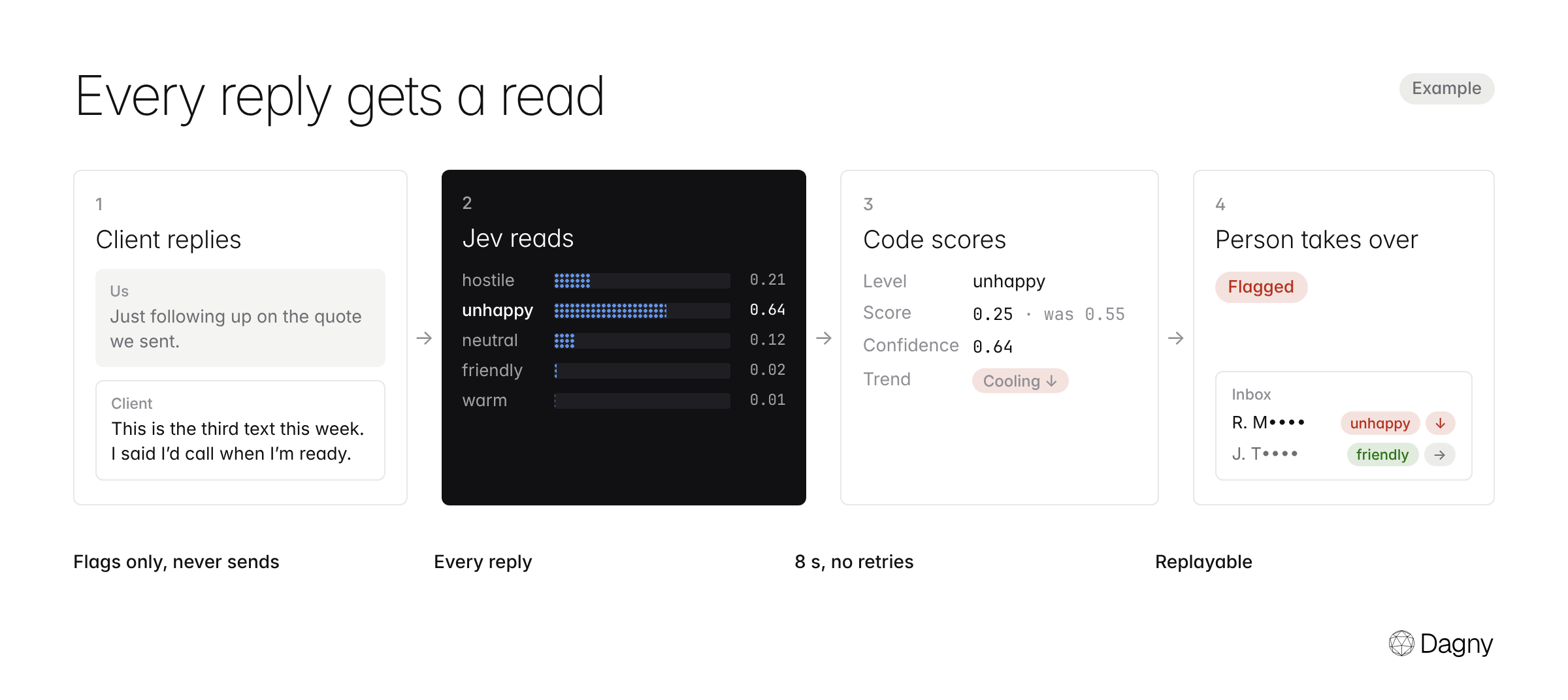
Jev runs on every reply, at the same time as the agent that drafts the response, and keeps running after a person has taken over. Replies that are only a stop or help keyword skip the read, because those replies are handled deterministically.
The read can only flag. What happens next is up to rules we write: the routing that decides who picks up a conversation can check the level, and a follow-up sequence can branch on how the last reply read before the next message goes out.
For the segment view, every read is stored per message, so the reads roll up. For any group of conversations we can see the split from hostile to warm and the share that's positive or negative.
This is where a typed, calibrated and fast answer pays off. The pattern matches the pipeline. Jev answers a narrow question and plain code decides what happens next, which here means flagging low sentiment in real time and routing the conversation to a person while the client is still in the thread.
What we'd tell a data team
Look for the places in your stack where you need a quick decision or a classification. Is this record in or out? Which bucket does it go in? Is this reply friendly or not? Those questions don't need open-ended reasoning, they need a typed answer you can trust and check, which is exactly what a System One model is built for.
If you want to see how we run Jev in production, DM me, or read more about how we work with data teams at dagnyai.com.